
Buccal Massage, Jaw Tension & TMJ: Why Your Face Can Hold More Than You Realise
If your jaw is constantly tight, you wake up with a sore face, you catch yourself clenching during the day, or your temples feel like they’re working overtime, you're not imagining it.
The jaw can carry a surprising amount of tension.
And often, it isn't just the jaw.
The muscles around the cheeks, temples, face and neck can become part of the same pattern - particularly when clenching, grinding, stress or prolonged concentration become habitual.
At Linear, this is where Buccal + TMJ Release comes in.
Not as a replacement for dental or medical care, and not as a promise to “fix” TMJ.
Rather, as a form of considered manual work for people who notice they are carrying a lot of tension through their face and jaw.

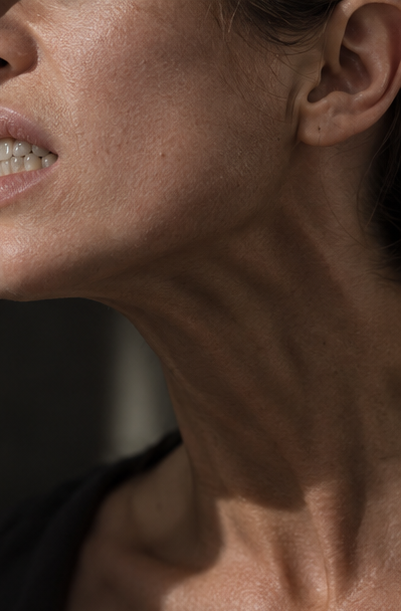
What is TMJ?
TMJ stands for temporomandibular joint - the joint where your jaw meets your skull, just in front of each ear.
You have two of them, and they work every time you speak, chew, swallow or open your mouth.
When people say they have “TMJ”, they are often actually referring to temporomandibular disorders, or TMD - a broad group of conditions involving the jaw joints and/or the muscles used to move the jaw.
Symptoms can include jaw pain, stiffness, difficulty opening the mouth, locking, painful clicking or popping, headaches and pain that spreads into the face or neck.
But jaw tension doesn't automatically mean you have TMD.
Sometimes it's simply a pattern of muscular tension that has built up over time.
And that's where paying attention to what your jaw is actually doing becomes important.

Why do we clench our jaw?
Clenching and grinding - known as bruxism - can happen while you're awake or asleep.
And it's not always something you consciously notice.
During the day, you might catch yourself holding your teeth together while concentrating at your computer, driving, exercising or dealing with stress.
At night, you may have no awareness of what's happening at all.
Stress, mood and psychological factors can contribute to bruxism, alongside a range of other factors including genetics, medications, alcohol and caffeine.
This is one reason I find the relationship between the jaw and emotional state so interesting.
We don't experience stress purely as a thought.
Our bodies respond to it.
And sometimes that response becomes physical.
You might notice yourself:
tightening your jaw when you're stressed
pressing your lips together when you're frustrated
holding your breath while concentrating
raising your shoulders
tensing your face without realising
waking up with tired or tight jaw muscles
Over time, these patterns can involve more than the masseter alone.
The muscles of the temples, cheeks, jaw and neck can all become part of how we hold and respond to tension.
Your jaw is not working in isolation

The masseter gets a lot of attention and for good reason. It's one of the major muscles involved in chewing.
But it's not the only muscle involved in facial and jaw movement.
The temporalis, medial and lateral pterygoids, buccinator and other facial and neck muscles all contribute to movement and function around the jaw and face.
This is why I don't think facial tension should always be viewed as a single-muscle problem.
Sometimes the more useful question is:
What pattern is your face participating in?
Are you clenching?
Are you grinding?
Are you holding your jaw during the day?
Are you carrying tension through your temples?
Do you feel it through your neck?
Are you waking with a tired face?
Or does your whole face simply feel like it never quite switches off?
Understanding the pattern matters.
Where Buccal massage comes in
Buccal massage is a form of manual facial work that accesses the muscles and soft tissues of the cheeks and jaw from both inside and outside the mouth.
At Linear, the treatment combines intraoral and external techniques with slow, considered movements through the cheeks, jaw, face and surrounding structures.
The goal isn't to force the face into a particular shape.
And it isn't about how much pressure you can tolerate.
It's about working with areas that feel tight, restricted or overworked.
Manual therapy targeting the jaw and surrounding soft tissues has been studied as part of conservative care for TMD, with research suggesting it can help with pain and jaw function, although results vary between techniques and individuals.
That distinction matters.
Buccal massage isn't a cure for every cause of jaw pain.
It isn't a substitute for assessment if you have persistent or significant symptoms.
But for someone who carries a lot of muscular tension through the face and jaw, it can be one useful part of a broader approach.


Your face can tell you a lot
One of the things I love about this work is that people often become much more aware of their own patterns once they start paying attention.
You might realise you clench every time you answer an email.
Or that your jaw is tight by 3pm.
Or that you hold your breath when you're concentrating.
Or that your face feels completely different after an hour of slow, intentional manual work.
None of that means there is something wrong with you.
It means your body is responding to your environment.
And sometimes awareness is the first step towards changing the pattern.
Buccal + TMJ Release at Linear
At Linear, Buccal + TMJ Release is designed for people who feel like they're carrying tension through their face.
We work through the inside and outside of the mouth, cheeks, jaw, face, neck and surrounding tissue using slow, intentional manual techniques.
The treatment is not about making your face smaller, forcing a dramatic release or chasing pain as a measure of effectiveness.
It's about creating space to notice what you're holding and working with the areas that feel overworked.
Because sometimes your jaw isn't asking for more pressure.
It's asking for a different kind of attention.
Buccal + TMJ Release is available at Linear, Henley Beach, Adelaide.